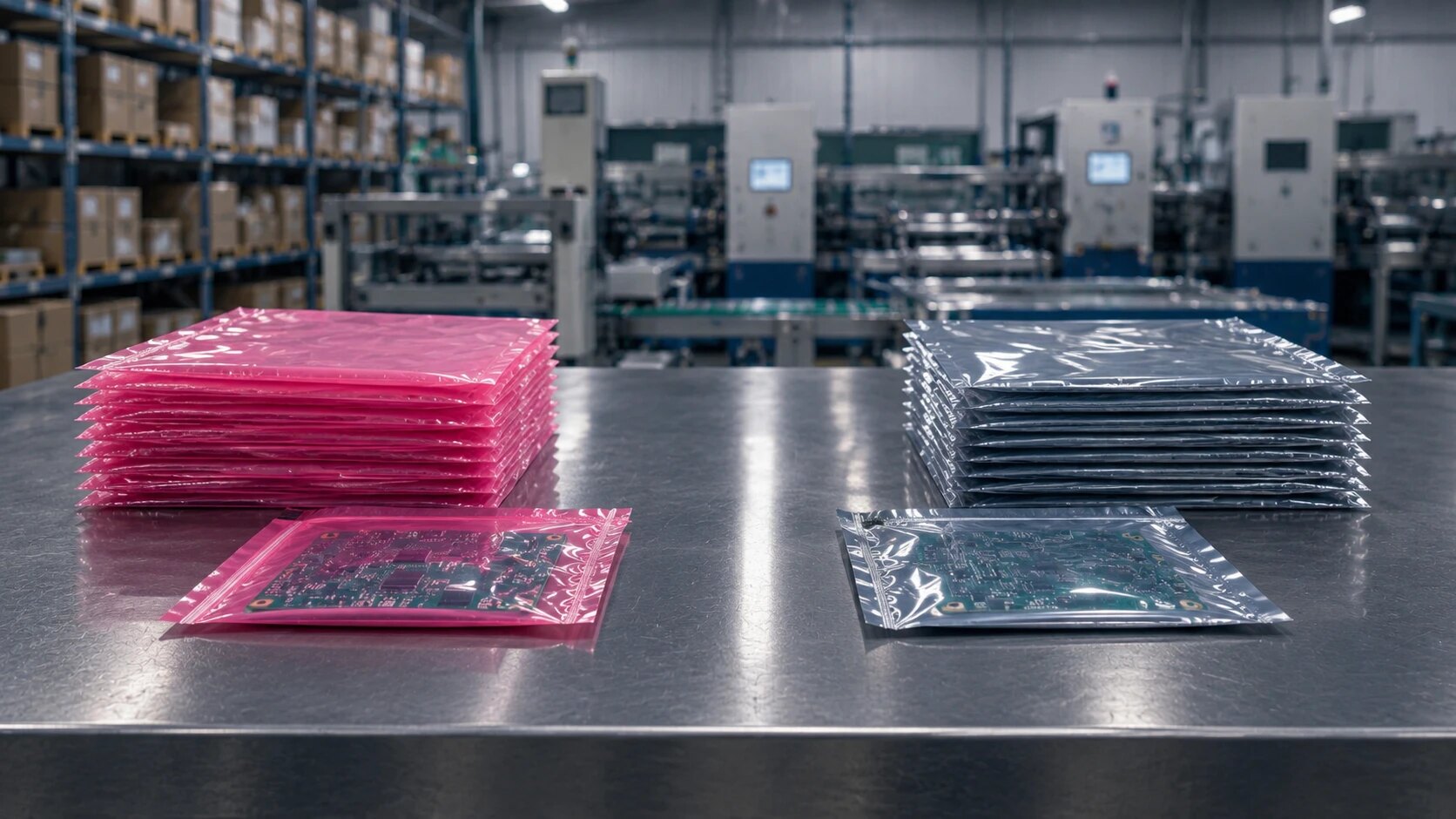
What ESD is, and why parts get damaged
ESD (electrostatic discharge) is a discharge of static electricity: the small spark you feel when you touch a door handle after walking on a carpet. It does a person no harm. A sensitive electronic part can be damaged by a discharge far weaker than anything you can feel.
The damage is not always visible at once. Sometimes the part keeps working and fails only months later, at your customer's site.
The risk comes from two directions: charge created by friction, for example when an ordinary bag rubs against the part in transit, and a discharge from outside: from a hand, a surface or another package. A pink bag deals mainly with the first. A shielding bag deals with both.
The pink anti-static bag: what it does and what it doesn't
The pink bag (pink poly, also called an ESD bag or anti-static bag) is polyethylene with an anti-static additive. The pink color is only a marking, so it is not mixed up with an ordinary bag.
What it does: it reduces the charge created when the bag rubs against the part or against other bags. That makes it suitable for storing and sorting inside an ESD protected area, and for items that sit near sensitive parts.
What it doesn't do: it does not block a discharge from outside. If a charged person touches the bag, the discharge can pass through it to the part.
Manufacturers also note that the anti-static property weakens over time and in very dry air.
The silver shielding bag: how it protects
A shielding bag (static shielding bag, also called a metallized bag) is built in layers: an anti-static plastic layer inside, a thin metal layer in the middle and a protective layer outside. The metal layer is thin enough to see the part through it.
When the bag is closed, the metal layer surrounds the part on every side and works like a "Faraday cage": a discharge that hits the bag from outside spreads over the metal layer and does not reach the part. The inner layer keeps the part itself from charging by friction.
- The bag protects only when it is closed: with its zip, folded over with a label, or heat sealed.
- A hole, a tear or a sharp crease in the metal layer weakens the shielding.
- A shielding bag is made to protect against static electricity. Shielding from radio interference (EMI/RF) is a separate property, checked in the manufacturer's specification.
Side by side
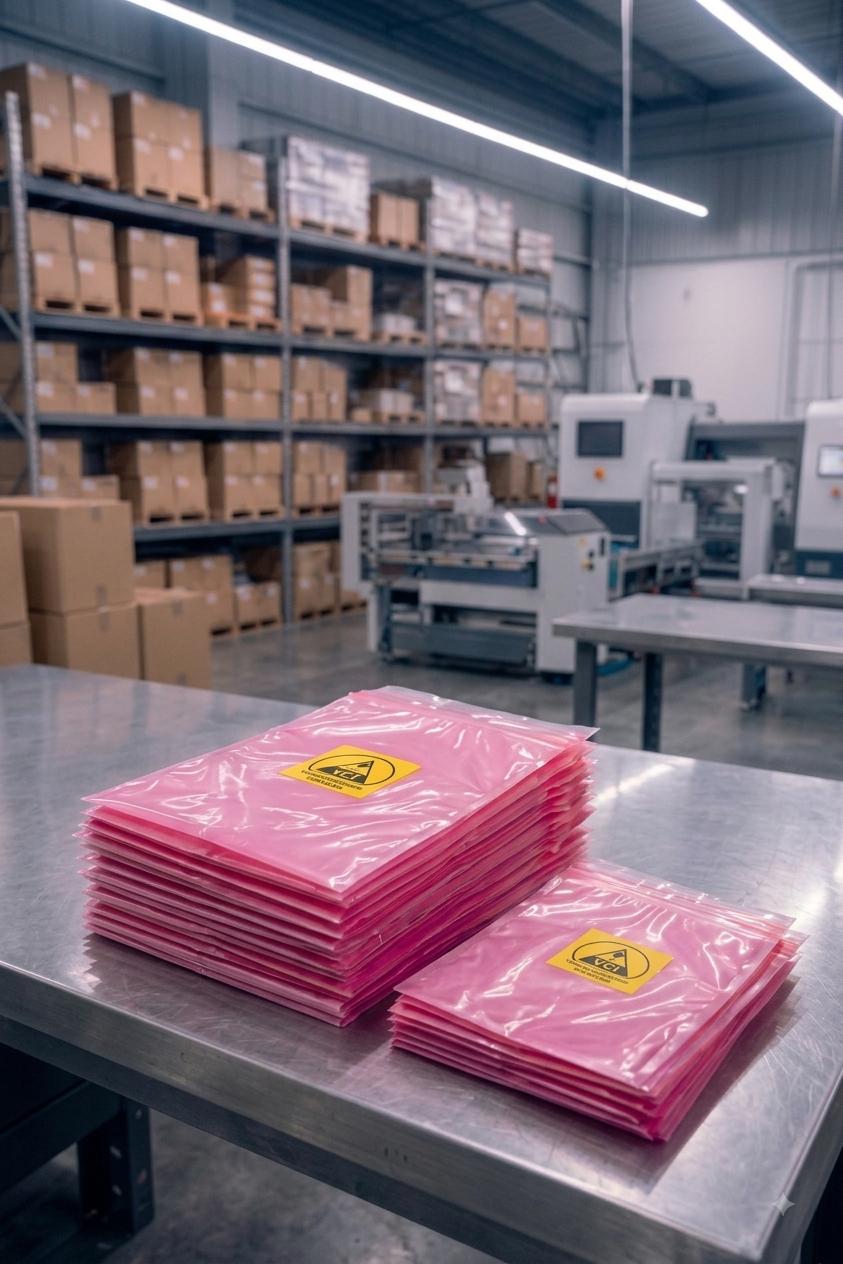 Anti-static (pink) | 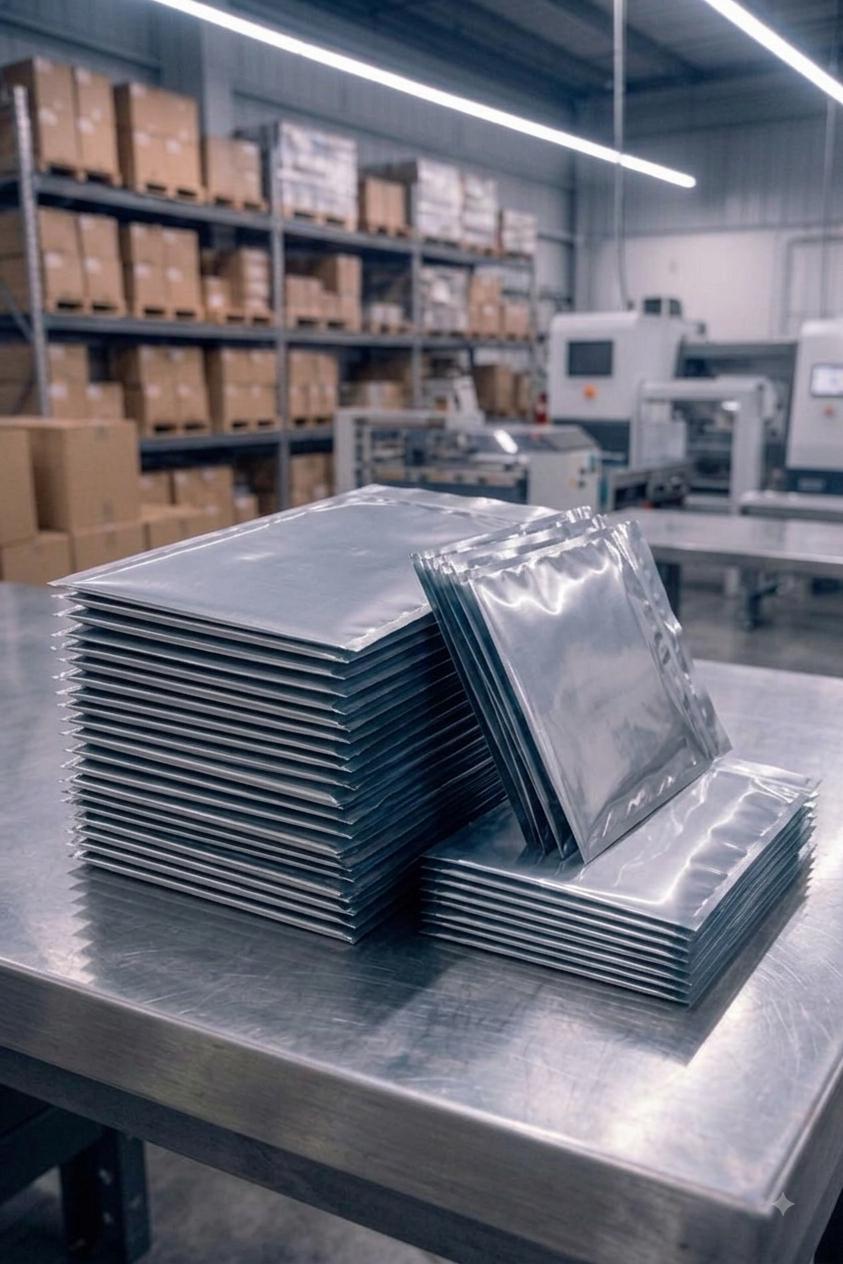 Shielding (silver) | |
|---|---|---|
| Keeps charge from building up by friction | Yes | Yes, in the inner layer |
| Protects against a discharge from outside | No | Yes, when closed |
| You can see the part inside | Yes | Partly |
| Where it is used | Inside an ESD protected area | Outside it too: warehouse, shipping, returns |
| Sensitive to creases and holes | Low | High |
| Price | Lower | Higher |
How to decide: three questions
- Is the part sensitive to ESD? Processors, memory, populated boards and sensors usually are; the maker marks it on the packaging or in the datasheet. Screws and nuts are not, but if they go into an area with sensitive parts, a pink bag keeps them from building up charge.
- Does the part leave the protected work area? Shipping to a customer, an ordinary warehouse, travel between sites and returns for repair are all "outside the area". There it needs a closed shielding bag. The usual ESD control standards (for example ANSI/ESD S20.20) also require packaging that protects against discharge for a sensitive part leaving the protected area.
- Is the part also sensitive to moisture? An ordinary shielding bag is not a moisture barrier bag. Moisture-sensitive parts need a different kind of bag; check the part maker's requirements.
Common mistakes
- Shipping a sensitive part to a customer in a pink bag alone. Inside the plant it is fine. On the way to the customer it does not protect against a discharge from outside.
- Leaving a shielding bag open. Without closing it, there is no complete "cage" around the part.
- Reusing a creased or torn shielding bag. A sharp crease or a hole damages the metal layer. Replace a damaged bag.
- Cushioning with ordinary bubble wrap. Ordinary bubble wrap builds up charge by friction. Put the part in a shielding bag, and fill around it with anti-static bubble wrap.
- Opening the bag on an ordinary table. Take the part out at a protected workstation, with the person handling it grounded.
What we offer
Kpack has both kinds, with a zip closure: pink anti-static bags and silver shielding bags. You can order either in the size you need, and we send the manufacturer's documents on request.